
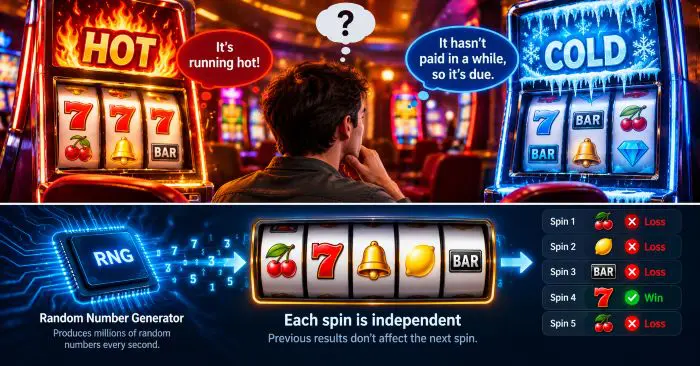
I have worked closely with slot players, examined game math sheets, and observed numerous instances of players making poor decisions resulting in significant financial losses. The goal of this article is to explain why the notion of “hot” and “cold” Slots seems logical, explain why the concept fails when viewed from the perspective of how Slots operate, and discuss alternative information that players can focus upon.
What slot players mean when they talk about “hot” and “cold” Slots
Typically when someone refers to a slot machine as being ‘hot‘, they imply that the machine has paid off recently and therefore will continue to do so. Therefore a “hot” slot is essentially in a ‘generous‘ mood. Conversely, when someone refers to a slot machine as being ‘cold‘, they generally mean that the machine has paid off infrequently and thus is in some type of ‘stingy‘ mode.
In addition to the concepts of ‘hot’ and ‘cold’, we also encounter the concept of ‘due‘. A ‘due‘ slot is simply a ‘cold‘ slot turned upside down. Essentially, both the ‘cold‘ and ‘due‘ slot concepts refer to the same thing – a machine that has failed to pay for a period of time. However, the logic behind the two is quite different. One person may be convinced that the machine will eventually begin to pay again because it is ‘due‘, while another person may be convinced that the machine won’t pay again until it begins to pay. Such a difference in perception should raise suspicions.
Additionally, we hear about the concepts of ‘loose’ and ‘tight.’ While these are slightly different concepts because they sometimes refer to something real (the return to player [RTP] for a given slot machine), players often utilize these concepts interchangeably with the concepts of ‘hot’ and ‘cold,’ implying that a slot machine’s RTP drifts during the course of a day. It is the latter interpretation that constitutes the myth.
How RNG determines every spin of a slot
All modern Slots (online video Slots as well as cabinets located within casinos) operate via a random number generator. Theoretically, this would be referred to as a pseudo-random number generator (PRNG), which generates extremely long sequences of randomly distributed numbers that meet statistical requirements for true randomness. Most land-based slot machines have their RNG continuously cycling through numbers thousands or millions of times per second, regardless of whether anyone is interacting with the machine. Typically, the result of an online game is produced on the server-side provider immediately prior to the player placing his/her bet.
At the instant that a user places their bet, the game utilizes the output of the RNG as input and then maps it onto a result. The process of mapping a random number onto a result is where the game mathematics reside. For example, if a big win corresponds to a minuscule fraction of the potential numbers available, a small win corresponds to a larger fraction, and a loss corresponds to the largest fraction.
Players typically view the animated display (e.g., reels spinning and slowing down, wilds falling in place, scatter symbols appearing in succession accompanied by a drum-roll) as the actual result. However, this is merely an animated representation of the decision made at the moment the bet was placed. The actual result occurred simultaneously with the registration of the player’s bet.
This aspect of Slots is critical to understanding why the hot/cold mythology persists despite what truly happens inside Slots. The probability distribution utilized in creating every slot game is fixed. There is no mechanism (dial) that adjusts this distribution after a prolonged period of time without payouts or after several successive payouts.
Why slot Spins are independent events
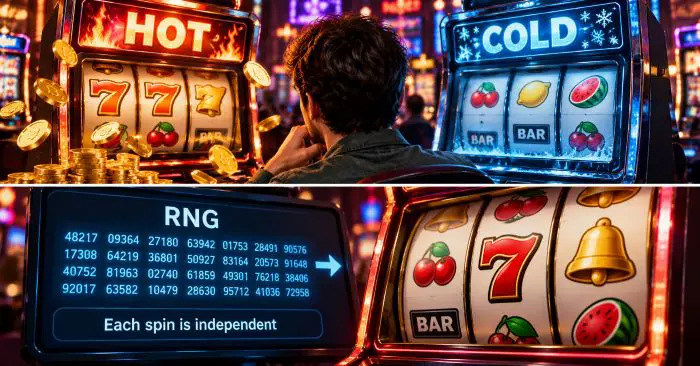
Slot Spins are independent events. The outcome of spin #501 has absolutely no relationship to spin #1 through #500. By definition, a slot machine has no recollection of what it paid you, what it paid the preceding player, or how long it has been since it paid out.
Individuals struggle with accepting this fact because “does a slot machine have memory?” Seems to require a complex response. It does not. In properly designed and audited games, the previous spin has no effect on the next spin. While slot machines do maintain transactional logs (for accounting and auditing purposes – e.g., meters tracking money-in/money-out/games-played), those logs do not feed back into generating outcomes. Logging transactions is entirely distinct from having your outcomes impacted by your transaction history.
To illustrate this further consider a perfectly balanced dice. Regardless of whether you obtain five sixes in consecutive rolls, the odds remain constant that you will obtain a six on your sixth roll. Your dice did not become “hot.” It cannot recall its own performance.
While a die provides an overly simplistic illustration of this concept, slot machines possess significantly more complexity due to thousands or millions of potential face values. Nevertheless, the principles are fundamentally equivalent.
Due to this independence between each spin, timing slot machine Spins is impossible. Many players believe that by pressing spin at a specific moment or stopping reels prematurely, they can alter their likelihood of obtaining a specific number. Due to the incredibly fast rate at which RNG algorithms cycle through numbers relative to human reaction time and because the outcome occurs at precisely the moment your spin is registered, this is physically impossible.
Why winning and losing streaks continue to occur
Although slot Spins are truly independent events and therefore do not share any inherent relationships regarding future Spins, why do winning and losing streaks appear to occur so frequently? Because they really do occur with reasonable frequency. Random processes create streaks all of the time. What does not occur with regularity is interpreting streaks as indicative of future trends.
Many individuals hold incorrect intuitions regarding randomness. The majority of individuals tend to assume that random results will display nice, consistent alternations between wins/losses. True randomness tends to manifest itself in a more uneven manner. Consider flipping an honest coin 100 times and observing multiple stretches of either 6-7 heads/tails throughout the sequence. Individuals who are presented with such a sequence tend to comment that it “looks unlike a random sequence,” although it embodies characteristics typical of randomness.
Slots exacerbate this tendency. Assume you’re playing a game that hits approximately 1 in 4 Spins (a 25% hit frequency), thereby returning something greater than zero (even if it’s smaller than your original wager) on nearly 25% of Spins. Then calculate the probability of experiencing 20 consecutive losses as follows: .75^20 = .003 (~1 in 315). This seems relatively improbable. However, assuming that you’re playing 600 Spins in an extended gaming session (which is not uncommon for many gamers) and many individuals engage in similar extended gaming sessions, then there exists ample opportunity for multiple lengthy droughts across thousands of players.
Similarly, statistical variance causes clusters of wins. Three bonus rounds within fifty Spins can cause One to feel that a machine has “awakened“. It’s simply short-term variance exhibiting what short-term variance does. Statistic variance in Slots is substantial over short sample sizes; and unfortunately, most gamers rarely reach beyond these ranges.
Games possessing higher volatility tend to accentuate everything mentioned above. A high volatility slot may offer low hit frequencies combined with large wins on occasion; therefore, protracted cold streaks are an inherent component of these games, not evidence that something has altered.
The gambler’s fallacy: why “due” Slots seem so credible
The conviction that a slot machine is “due” to pay after an extended losing run has a name – the gambler’s fallacy. It represents the misconception that statistically independent random events compensate for each other on a short-term basis; hence, if you observe repeated occurrences of One event, then it increases your chances for witnessing an occurrence of the opposing event.
Historically speaking, perhaps the most celebrated example occurred at roulette in Monte Carlo in 1913 when black obtained twenty-six consecutive wins. Subsequently gamblers lost considerable sums betting on red, convinced that it must occur soon. The wheel remained indifferent.
Practical steps for playing Slots without pursuing hot or cold trends
Unfortunately for adherents of hot/cold mythology, there is more than just flawed theory associated with pursuing such beliefs. There are behavioral consequences. Beliefs in “due” Slots encourage individuals to continue playing at machines beyond when they intend to leave; beliefs in hot Slots motivate winners to continually gamble additional funds. Both ultimately contribute toward loss-chasing behaviors — arguably among the most costly habits in slot gaming.
Therefore, treating Slots as paid entertainment with established average costs and lots of randomness associated therewith is preferable. Prior to beginning, determine your session bankroll (i.e., the amount you are willing to lose); establish your loss limit (whereby you cease playing once reached); establishing your win limit (at which point you stop playing or withdraw funds) likewise serves to prevent adherence to the “it’s hot – let me play more” mentality.
Finally, pacing is more important than many realize. Rapid play leads to exhausting your session bankroll at virtually the same expected cost per spin. As part of its efforts to protect vulnerable consumers from rapid play (quick-spin/autoplay), in 2021, the united kingdom outlawed autoplay and quick spin capabilities on online Slots; similarly, as part of regulating autoplay and quick spin capabilities, setting a minimum spin duration for online Slots remains One simple means of prolonging your bankroll.
As stated previously here are some easy-to-follow steps that function far better than any “hot” or “cold” strategy:
Determine your total budget and session length prior to initiating your first spin
Select your game(s) according to rtp and volatility – not based on recent performance
Establish deposit limits, time reminders & reality checks via casino provided tools
Cease play upon reaching your predefined loss limit – no exceptions!
Take a break if you find yourself mentally labeling a game as owning you money
Hot/Cold Slot FAQ
Q. Are there really “hot” and “cold” slot machines?
A. No. Not the way you think. The only type of “streaks” your favorite slots can create are based on luck alone. This means “hot” or “cold” (or anything else) does NOT equal a winning or losing machine – the next spin is always at the same chance of winning.
Q. What’s a “hot” slot machine?
A. It is when a player thinks their machine is currently “paying.” They’ve won recently so they believe this is now a time to bet big. But what happened was just a random cluster of wins – nothing to indicate its future winnings will be greater.
Q. What’s a “cold” slot machine?
A. When a player believes their machine is being “tight,” because it hasn’t paid them lately. It is important to remember that this machine did not become tighter; it simply experienced a streak of bad luck that all random systems will experience from time to time.
Q. Is my favorite slot machine ever going to “owe me?”
A. No. Your favorite slot machine never accumulates any type of obligation to give back money. To continue believing otherwise is known as the Gambler’s Fallacy, and it is probably the #1 reason why many gamblers end up playing much longer than they intended.
Q. Does my last spin affect my next spin?
A. Absolutely not. Each spin on a properly certified slot machine is truly an independent event. A win, lose, or almost-win on the last spin has absolutely no influence whatsoever on your next spin.
Q. Why do we see streaks of good/bad luck on slots if they are truly random?
A. Because randomness is inherently streaky. As the sample size gets smaller (i.e. as you get closer to experiencing something yourself), you’ll notice streaks of random wins and/or losses.